The initiative is part of Edunext - Next Education Italia, a national network for innovation in digital education funded by the MUR with PNRR resources and involving 35 universities and 5 AFAM institutions, as well as more than 700,000 students and 25,000 professors and researchers.
Edunext Degree Courses, made available according to guidelines and elements shared within the Hub, are designed by reference professors according to an innovative teaching model called ECOBI - Educational Cluster, Open Badge, Blended Intensive Program.
The degree courseis delivered in the predominantly distance learning mode, i.e., it involves 75% distance teaching and 25% in-presence teaching.
The teaching follows the "BIP" Blended Intensive Program, that is, it provides for both online and in-presence classes to be concentrated in specific periods, so as to reduce costs and time spent on travel, offering a complete college experience even for those who cannot attend full-time.
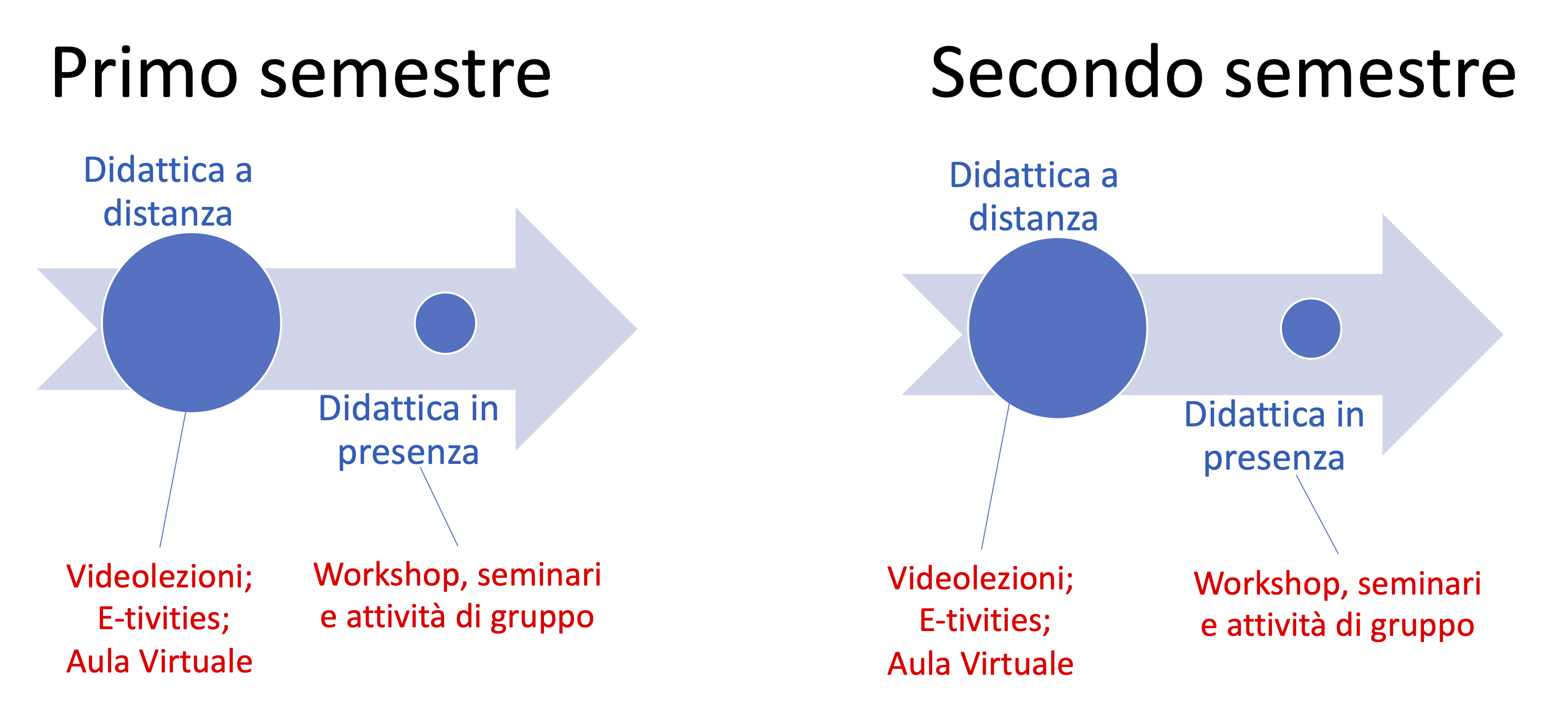
In particular, the first part of each semester is dedicated exclusively to online teaching, while in the second part, in specific and concentrated weeks, in-person teaching will be delivered.
The online teaching is designed following a modular pattern, so that students can enjoy the video lectures according to their needs and time availability and with the support of tutors and professors. During online delivery, the teaching is both erogative and interactive.
The erogative teaching consists of a set of video lectures lasting a maximum of about 15-20 minutes each.
The interactive teaching, on the other hand, is delivered in the form of e-activities, i.e., activities to be carried out online asynchronously (ex.: assignments, group work, self-assessment quizzes, forums, etc.) and synchronous activities, such as Virtual classrooms, in web-conference mode, with defined appointments, to delve into and interact remotely with other students and professors on course topics.
In-presence learning is designed for it to be a participatory, shared and as interactive experience as possible. Hence, the hours of in-presence teaching will be grouped in dedicated and intensive weeks, and will be devoted to laboratory and collaborative activities, specialized seminars, group activities, writing papers and projects, etc... and not to classic frontal teaching classes.
This division between online and in-presence teaching applies uniformly to all course units.
Integrated course units (Educational Cluster)
Educational programming is structured into integrated course units called Educational Cluster that are worth 12 CFUs and include modules of 3 CFUs each.
An Educational cluster is integrated because it consists of modules that are designed and presented as a unitary course, are interdisciplinary, and present various aspects of a theme in an interconnected way. The goal is to provide a more comprehensive and holistic education.
The Educational Clusters are, therefore, to be considered as course units and, although each module provides for in-progress assessment and evaluative tests of various kinds that will produce microcredentials and certifications in the form of badges for students, there is no requirement for a profit exam for each module, but the passing of a single integrated exam for the entire Educational Cluster, which will produce a single final grade and related CFUs.
E-tivities and virtual classroom
The e-tivities, fundamental to the organization of interactive teaching, are structured learning activities that take place online, asynchronously, and are designed to actively engage students, promoting interaction and critical thinking.
E-tivities are exercises designed for the web, a way to organize online learning in active and participatory ways.
Each e-tivity defines a well-defined task that students must complete. By way of example, tasks can range from discussions on a specific topic, to analysis of case studies, production of written papers, multimedia presentations, or online assessment tests. There is also at least one weekly Virtual Classroom via videoconference for in-depth study and interaction.
Course professors and disciplinary tutors facilitate the completion of the e-tivity by providing guidance, moderating discussions, and offering feedback to students on their work in order to promote motivation and ensure that the activities achieve their educational objectives.
The proposal for each e-tivity involves the acquisition of a particular skill, the understanding of a key concept, or the completion of a collaborative project. Within each module, e-activities are linked to the achievement of microcredentials and certifications through Open Bagde.
Open Badge, microcredentials and CFUs.
Passing single course units within an Educational Cluster will not originate a passing grade for the student (which will be obtained by passing the integrated course exam) but will allow the student to obtain an Open Badge certifying one or more competencies achieved by the student.
An Open Badge is a digital attestation that takes the form of an image containing numerous metadata. It is issued to the student at the completion of each cluster module and also at the completion of each cluster (Milestone Badge).
The Badge allows the skills acquired and experiences gained to be visible and easily shared, guaranteed by the credibility of the organization that issued it.
All modules thus issue digital certifications of the skills acquired, which allow students to build an e-portfolio recognized at the European level. These competencies are consistent with a European-recognized standard, the EU-ESCO classification, (European Skills, Competences and Occupations), the multilingual European classification of skills, competences and occupations.
ESCO functions as a dictionary, describing, identifying and classifying occupations and vocational skills relevant to the EU labor market and education and training.
Course unit testing methods and final test
The verification of students' preparation for each Syllabus is divided into two stages: the first involves passing the assessment tests of the individual modules, the second is represented by the Educational Cluster exam (integrated on all module contents).
For each 3 CFU module, assessment tests are scheduled, which can also be distance in proctored mode, to ensure the smooth running and traceability of the test.
Each professor will indicate to the students which in-progress tests, interactive and participatory activities etc. (e-tivities) they must complete during the module in order to pass it, obtain the Open Badge(s) and related certified competencies.
On completion of the four modules that make up an Educational Cluster and obtaining the related Open Badges, the student is admitted to take, in presence, the proficiency exam before an integrated board.
All the professors of an Educational Cluster, together, design and indicate to the students the modalities of the profit examof the Educational Cluster, which will enable them to obtain:
the profit grade
the CFUs corresponding to the Educational Cluster
a Milestone Badge (an "enhanced" Open Badge since it includes all the integrated skills that the cluster has enabled).
The CFUs and the grade will flow into the student's academic career, reported on the individual profile in the ESSE3 portal of the University of Parma.
The Open Badges will flow into the digital profile made available in the Hub's teaching platform, can be reported on one's CV and enhanced for future work experience.
The final test (discussion of the degree thesis) is also held in presence, according to the modalities established by the Course Regulations.
Disciplinary tutors
In the Management engineering degree course with predominantly distance delivery of classes, instructional design constitutes the result of the joint work of professional figures with different expertise and skills who contribute to make learning paths structured, of quality and sustainable in the development of teaching activities (ex. group work, formative assessment, feedback, student support).
Professors, instructional designers and disciplinary tutors are the figures around which the educational narrative revolves.
The discipline tutors play a crucial role in supporting students during their digital learning journey. The presence of qualified tutors, selected with specific skills and qualifications for the Course to be tutored, is essential to ensure that students receive the assistance they need to understand and assimilate the learning content, overcome difficulties in approaching study, and maintain high motivation.
The roles and responsibilities of disciplinary tutors include:
● Academic support: disciplinary tutors provide academic support, helping students understand key concepts and resolve any doubts about course content. This support can be provided through online tutoring sessions, discussion forums, e-mail, and other communication platforms.
● Progress Monitoring: another key task of disciplinary tutors is monitoring students' progress. They check that students complete tasks and meet deadlines, offering timely and constructive feedback to improve their performance.
● motivation and coaching: disciplinary tutors also play a key role in keeping students' motivation high, encouraging them to persevere in difficult times. They provide emotional support, helping students manage stress and maintain a positive attitude toward learning.
● Interaction facilitation and e-tivity: finally, promoting interaction among students is another important responsibility of disciplinary tutors. They facilitate the creation of study groups, participation in online discussions, and other collaborative activities that enrich the learning experience.
Spaces and infrastructure for advanced education
The Management engineering degree course with predominantly distance delivery of classes, provides its students with spaces and infrastructure for advanced teaching.
In particular, the Course will have at its disposal a dedicated classroom (Classroom G, in the Science Complex at the University Campus) that supports face-to-face, interactive and collaborative teaching.
The classroom is set up with state-of-the-art audiovisual and multimedia equipment and functional furniture for innovative teaching, in order to ensure the best performance of the activities designed according to the ECOBI teaching model.
Students will also be able to freely use the spaces dedicated to them as study rooms or as spaces to meet, carry out e-activities and collaborative activities in groups, and deepen themes and discussions that emerged during the video lectures.
The course will be held in the University's University Campus.